
Imagine spending months building a piece of content — optimizing it, earning backlinks, watching it climb to page one — and then realizing the person who searched for it never actually landed on your site. Google just… answered for you.
That’s not a nightmare scenario anymore. It’s Tuesday.
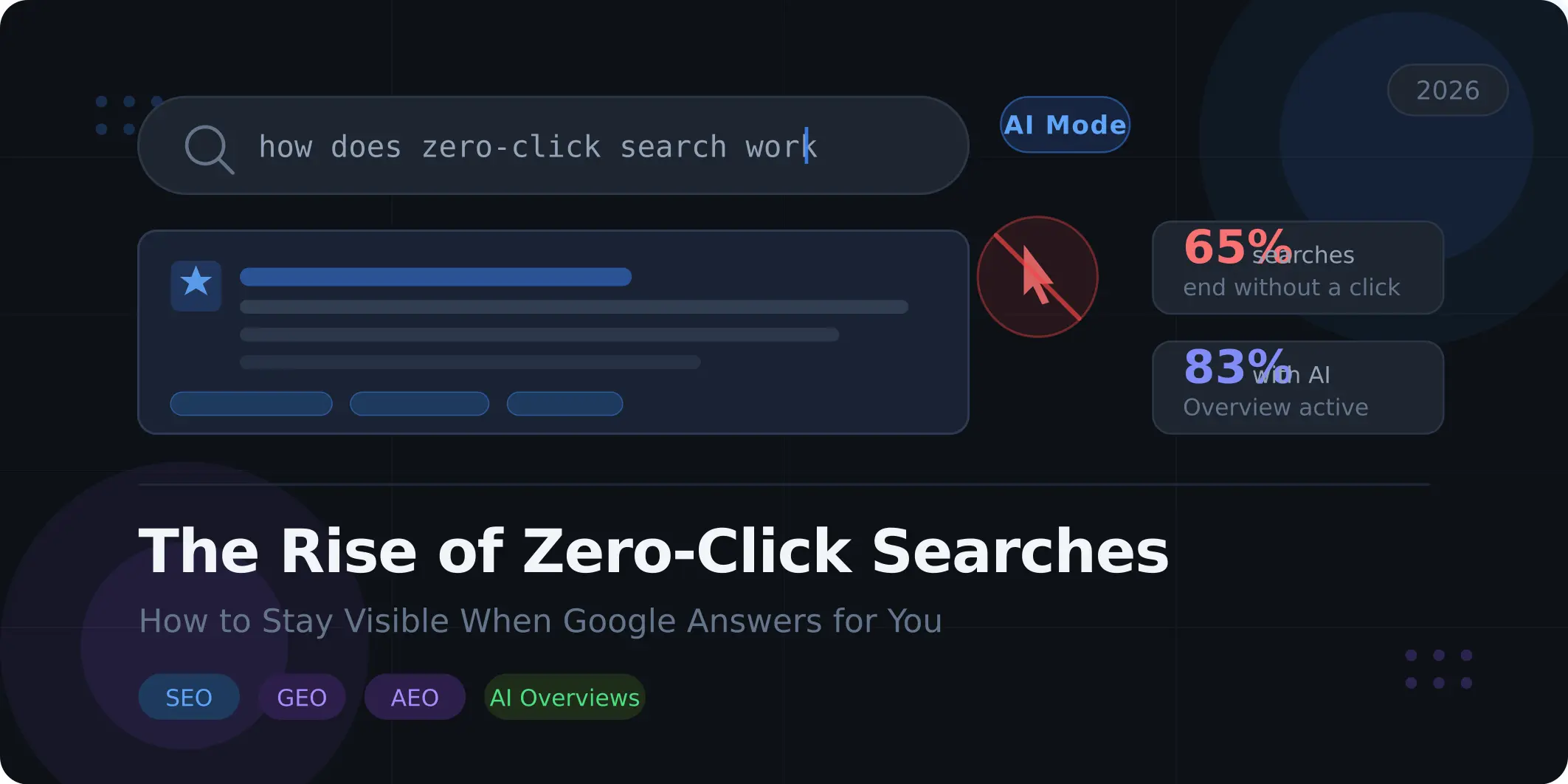
In 2026, nearly two out of every three Google searches end without a single click to any website. Your content showed up. Google read it, summarized it, and handed the user their answer — all on the search results page. No visit. No session. No conversion opportunity.
This is the reality of zero-click search, and it’s reshaping how every marketer, content creator, and business owner needs to think about visibility online.
But here’s what most people get wrong: they treat this as a death sentence for SEO. It isn’t. It’s a structural shift — and if you understand what’s actually happening, there’s a real playbook to follow.
What Is a Zero-Click Search, Actually?
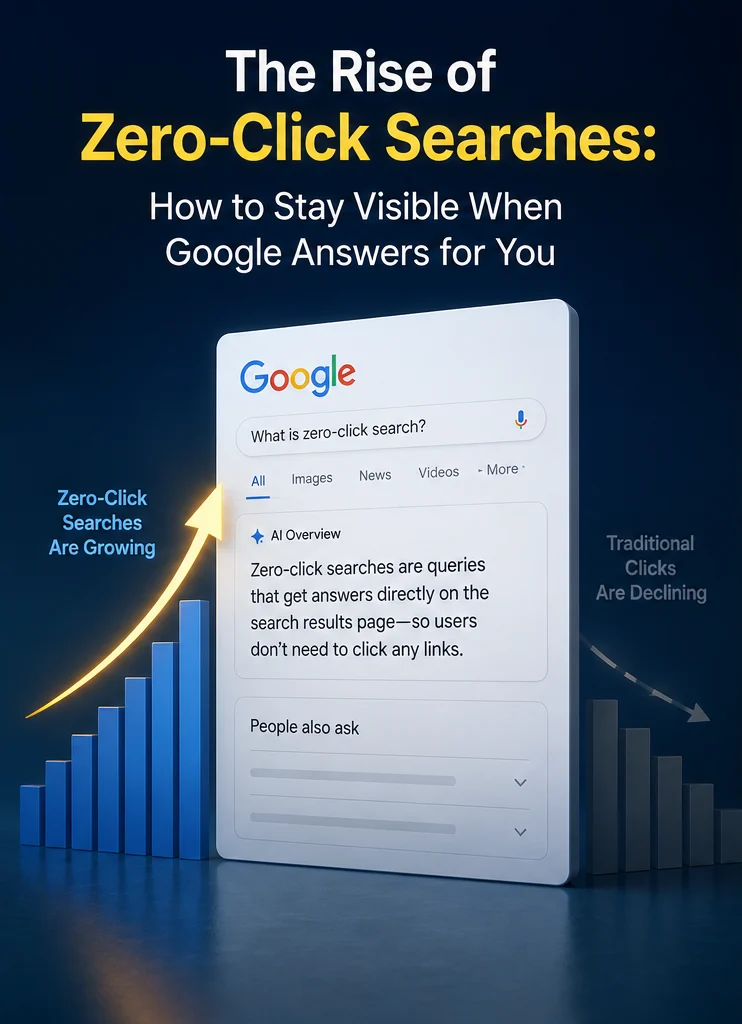
A zero-click search is exactly what it sounds like: a user types a query into Google, gets their answer directly on the results page, and leaves without clicking on anything.
This isn’t a new phenomenon. It started long before AI entered the picture. When Google introduced Featured Snippets, Knowledge Panels, and the “People Also Ask” boxes, they began answering questions before users even had to scroll. Currency conversions, weather forecasts, sports scores, word definitions — all of these have been producing zero-click results for years.
What’s changed in 2026 is the scale and the sophistication of those on-page answers.
Here are a few everyday examples:
- You search “how long does melatonin take to work” — Google’s AI Overview gives you a structured 3-sentence answer with dosage context. Done. You leave.
- You search “best time to visit Bali” — an AI Overview pulls together seasonal data, rainfall charts, and crowd info. No travel blog gets the click.
- You search “difference between LLC and sole proprietorship” — a clean comparison table appears above every legal firm’s blog post.
The user got what they needed. You got nothing — not even an impression that converted.
The Numbers You Need to Know
Let’s put some hard data behind this because the scale is genuinely staggering.
The zero-click rate has climbed steadily for years — from around 50% in 2019 to 64.82% in 2026 according to SparkToro/Datos clickstream data. But that overall number actually undersells the problem when you break it down by context:
- Without AI Overviews: ~60% zero-click rate
- With AI Overviews: ~83% zero-click rate
- In Google’s AI Mode (the fully conversational interface): 93% zero-click rate
That last number is the one worth sitting with. In Google’s AI Mode, 9 out of every 10 searches end without anyone visiting a website.
AI Overviews themselves have grown aggressively. According to BrightEdge data, they now appear on roughly 48% of all Google searches globally — up 58% year over year. In the Education sector, that number peaks at 83%. And the organic CTR impact when an AI Overview appears? Studies show anywhere from a 15% to a 61% decline in click-through rates, depending on the query type.
For context: if your informational blog posts were getting 1,000 clicks a month a year ago, they may be getting 390 to 850 clicks today — for the same ranking position.
Why AI Overviews Changed Everything (And Why They’re Just Getting Started)
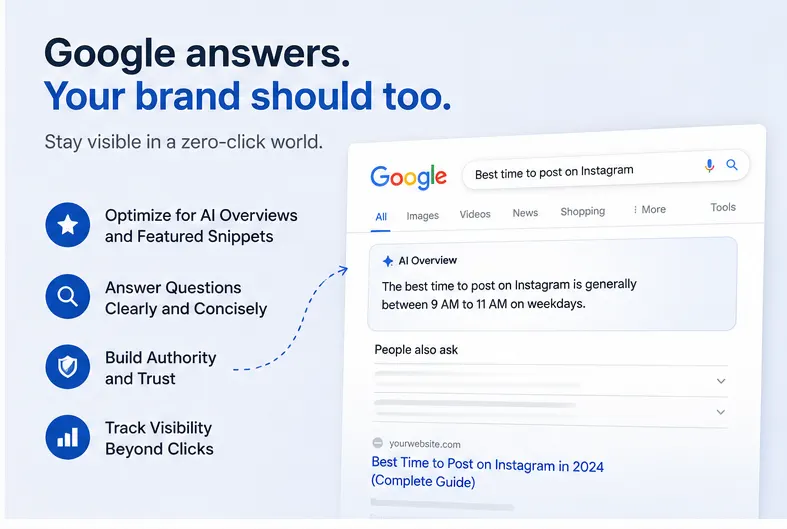
Google’s AI Overviews aren’t a feature. They’re a strategic repositioning of what Google’s product actually is.
For two decades, Google’s job was to be a library index — find the relevant documents and point you toward them. The website was the destination. Google was the door.
AI Overviews flip that entirely. Now Google is the destination. It synthesizes information from multiple sources, writes a coherent answer, and presents it as if it were Google’s own knowledge. The sources get a small attribution footnote at best.
This shift was predictable. Gartner had flagged that traditional search engine volume would drop 25% by 2026 as AI chatbots and virtual agents ate into market share. What nobody fully anticipated was how quickly Google would aggressively lean into that trend rather than fight it. Rather than protecting the traffic pipeline to publishers, Google optimized its product for the user experience of staying on Google.
The result? Sectors that built entire content strategies around informational queries — healthcare, finance, education, B2B tech — are getting the hardest hit. Meanwhile, transactional queries (where someone wants to buy something specific) are more protected because Google still needs to send users somewhere to make the purchase.
Who Gets Hit Hardest (and Who Doesn’t)
Not all content is equally exposed to zero-click erosion. Understanding this distinction is crucial before you overhaul your entire strategy.
High-risk content types:
- Definition and “what is” content (extremely high AI Overview coverage)
- How-to guides with simple step-by-step answers
- Comparison content (e.g., “X vs Y”)
- Historical facts and data lookups
- Health and wellness FAQs
- Travel and local information queries
Lower-risk content types:
- Long-form, experience-driven content (personal narratives, case studies)
- In-depth research with original data
- Transactional and commercial intent queries
- Brand-specific searches
- Complex, multi-part problem solving
- Content requiring a tool, template, or interactive resource
Here’s an important nuance: the clicks that survive are higher quality. When an AI Overview appears and a user still clicks through to your site, that person has already read the summary and wants more depth. Research shows those visitors convert up to 23% better than standard organic traffic. You’re losing volume but gaining quality — which only helps if your site is designed to convert that intent.
The Silver Lining Nobody Talks About: AI as a Traffic Channel
Here’s the part of this story that most SEO articles written 12 months ago completely missed.
Zero-click doesn’t mean zero-opportunity. It means the game has moved.
Starting in May 2026, ChatGPT made a significant behavioral shift — it began embedding direct links to brand websites inside its responses far more frequently. According to Similarweb, daily OpenAI referrals to websites roughly doubled (60–65%) within days of this change. The share of ChatGPT responses containing a URL jumped from about 4.5% to nearly 20–24% almost overnight.
This is a fundamentally different type of traffic than organic search. Users arrive at brand homepages, not specific articles — more like brand discovery than document retrieval. It’s closer to display advertising behavior than traditional SEO behavior.
The brands capturing this traffic aren’t doing anything mysterious. They’re the ones Google’s AI and ChatGPT already trust: those with strong domain authority, clear topical expertise, and content structured in ways that make it easy for AI systems to extract and cite.
Which brings us to the strategic response.
The Strategic Framework: SEO + AEO + GEO
If you’ve been purely playing the traditional SEO game — keywords, backlinks, technical optimization — you need to expand that playbook. The current landscape requires three overlapping disciplines working together.
Traditional SEO: Still Your Foundation
Here’s the most important thing to understand: you cannot skip traditional SEO and jump straight to AI optimization. Studies show a 92% correlation between pages ranking in the top 10 organically and pages being cited in AI Overviews.
The AI reads from the top results. If you’re not there, the AI won’t find you either. Technical site health, crawlability, backlinks, and page authority remain non-negotiable. Think of SEO as your ticket to the table where the AI is making decisions.
AEO — Answer Engine Optimization: Getting Cited
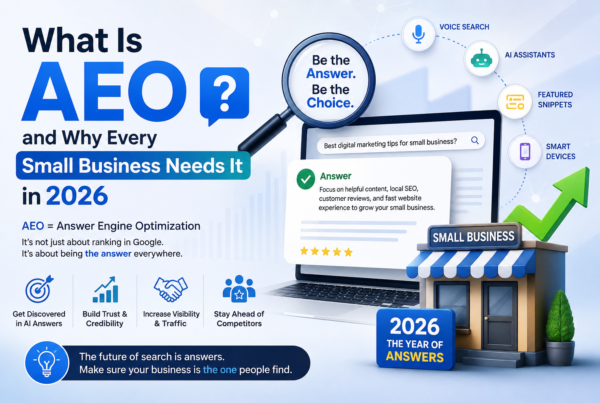
AEO is about structuring your content so that AI systems can easily extract and present specific answers. The core philosophy here is concision and structure.
The most consistent pattern among pages cited in AI Overviews is simple: the answer appears in the first two to three sentences following a clear question-based heading. If an AI has to dig through 500 words to find your answer, it won’t cite you. It will cite someone else who put their answer first.
Practical AEO implementation looks like this:
- Open every section with a direct, concise answer (40–60 words)
- Use question-based H2 and H3 headings that mirror real search queries
- Add FAQ sections with tight Q&A pairs
- Implement FAQ and HowTo schema markup so Google can structurally understand your content
- Make individual paragraphs and sections “self-contained” — able to stand alone if extracted
GEO — Generative Engine Optimization: Building AI Trust
GEO is the newest discipline, and it operates at a layer above content structure. It’s about making your brand and content the kind of source that AI systems inherently trust and gravitate toward.
The four dimensions of effective GEO:
1. Semantic Depth: Don’t just answer the surface question. Cover related subtopics, entities, and follow-up questions within the same content cluster. AI systems evaluate topical authority by looking at whether your content covers a subject comprehensively, not just accurately.
2. Structural Clarity: Use HTML tables for comparisons, numbered lists for processes, and proper schema markup (Article, FAQ, HowTo, Product) to create a kind of “nutrition label” for your content that AI can instantly parse.
3. Authority Signals: Your own website is not enough. AI systems — particularly ChatGPT — heavily weight backlinks and third-party mentions. Getting your brand cited in editorial publications, comparison roundups (“Best X for Y” lists), and authoritative industry sources dramatically increases your citation probability across AI platforms.
4. E-E-A-T Implementation: Google’s AI gives strong preference to content demonstrating Experience, Expertise, Authoritativeness, and Trust. This means real author bios with credentials, About pages that clearly establish expertise, first-person experience, original data, and citations to credible sources within your content.
7 Actionable Strategies to Stay Visible in a Zero-Click World
1. Audit Your Content for Zero-Click Vulnerability
Run your top-performing informational pages through a quick test: search each target keyword and see if an AI Overview answers it completely. If it does, that page’s traffic is at risk. Prioritize adding depth, original data, or a resource (tool, template, checklist) that requires a visit to your site to actually use.
2. Adopt an Answer-First Content Structure
Restructure key pages to lead with the answer, then expand. Think of it like an inverted pyramid — conclusion first, then context and detail. This format serves both AI extraction (which needs the answer quickly) and human readers (who want to know if they’re in the right place before committing to read).
3. Build Topic Clusters, Not Isolated Posts
A single blog post answering one question is increasingly easy for AI to consume and replace. A network of content covering every angle of a topic — pillar page, supporting articles, FAQs, case studies — signals genuine authority that’s much harder to sideline. More importantly, it captures users at multiple stages of an inquiry.
4. Earn Third-Party Mentions and Citations
This is one of the most underrated GEO strategies. AI systems pull heavily from sources they consider credible — which includes what’s written about you, not just by you. Getting featured in industry listicles (“Best X tools for Y”), earning mentions in editorial coverage, and building digital PR relationships are now direct inputs into AI citation probability.
5. Implement Structured Data Across Your Site
Schema markup is the fastest, clearest signal you can send to AI systems about what your content contains. At minimum, implement FAQ schema on Q&A sections, HowTo schema on instructional content, Article schema on editorial pieces, and Organization schema on your homepage and About page. Google doesn’t guarantee inclusion, but structured data significantly improves the odds.
6. Create Content That Requires a Click
The best long-term defense against zero-click erosion is building content that simply cannot be consumed in a SERP summary. Interactive tools, calculators, original research reports, downloadable templates, video walkthroughs embedded in posts, and community-driven content all require the user to actually visit. These content types are also far more likely to earn backlinks and third-party citations.
7. Track AI Visibility as a Primary Metric
Traditional click-through rate is no longer the full picture. You need to track whether your brand is being mentioned and cited in AI responses across platforms — Google AI Overviews, ChatGPT, Perplexity, and Gemini. Since May 2026, ChatGPT referral traffic is measurable in Google Analytics via utm_source=chatgpt. Set up tracking for this channel now, because it’s growing fast.
Common Mistakes to Avoid
Trying to opt out of AI Overviews entirely. You can use the nosnippet meta tag to block your content from AI Overview inclusion, but doing so also removes you from Featured Snippets and rich results — making your overall visibility worse, not better.
Writing AI-optimized content without an SEO foundation. If your page isn’t ranking in the top 10, AI Overviews won’t see it. GEO and AEO require strong traditional SEO underneath them. The pyramid doesn’t work without a base.
Measuring only clicks. If your AI Overview citation delivers 50,000 brand impressions and 2,000 high-intent visitors, but you’re only counting those 2,000 clicks against your old benchmarks of 10,000 clicks, you’ll think you’ve failed when you’ve actually shifted into a better position. Update your measurement framework.
Ignoring multi-platform AI visibility. Google AI Mode, ChatGPT, Perplexity, Gemini, and Copilot all have different citation preferences and algorithmic behaviors. The same brand can see citation volumes differ by 615x between platforms. You need to be present across all of them, not just optimized for Google.
Publishing thin, AI-generated content to chase volume. Google’s quality signals are increasingly sophisticated. While AI-written pages appear in over 17% of top search results, the winning formula is human oversight and original insight — not volume. Thin content may earn a brief citation but won’t build the authority that sustains long-term AI visibility.
SEO vs. AEO vs. GEO: A Quick Comparison
| Dimension | Traditional SEO | AEO | GEO |
|---|---|---|---|
| Primary Goal | Rank in organic results | Get cited as a direct answer | Appear in AI-generated responses |
| Key Signals | Backlinks, keywords, technical health | Structure, schema, concise answers | Authority, topical depth, earned mentions |
| Content Style | Comprehensive, keyword-optimized | Answer-first, FAQ format | Entity-rich, semantically dense |
| Measurement | Rankings, organic traffic | Featured snippet wins, voice results | AI citations, brand mentions, referral traffic |
| Time to Impact | Weeks to months | Days to weeks | Months (authority takes time) |
| Still Required? | Yes — it’s the foundation | Yes — increasingly critical | Yes — the new frontier |
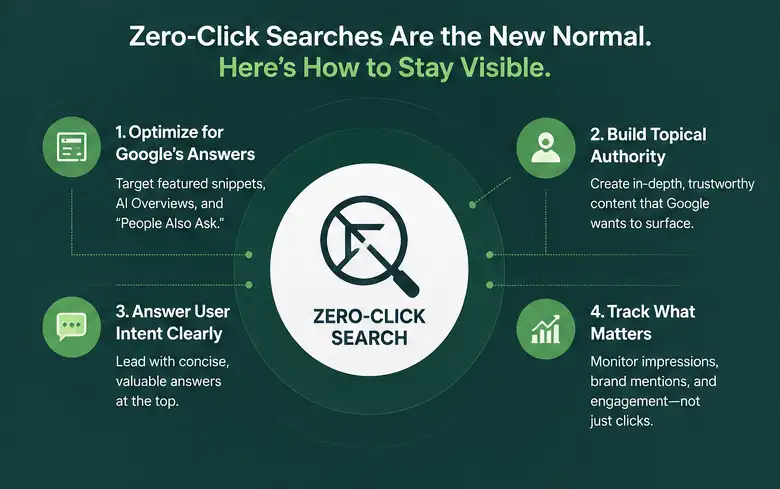
The takeaway: all three work together. Skipping any one of them leaves a gap in your visibility strategy.
Frequently Asked Questions
Q: Is SEO dead because of zero-click searches?
No. SEO is evolving, but it remains the non-negotiable foundation. AI Overviews pull from top-ranking pages, which means if you’re not ranking, you’re not being cited. The goal has shifted from winning clicks to winning citations and brand visibility — but strong SEO is still what gets you in front of the AI in the first place.
Q: Can I stop my content from being used in AI Overviews?
Technically yes, using the nosnippet meta tag. But this is generally a bad idea because it also removes you from Featured Snippets, rich results, and other high-visibility placements. The tradeoff makes it counterproductive for most sites. A better approach is to optimize for citation so your brand gets credited alongside the answer.
Q: Which types of queries are safest from zero-click erosion?
Transactional queries (where the user needs to complete a purchase or take an action), navigational queries (where the user wants a specific website), and complex research queries (requiring nuanced, multi-source analysis) are the most protected. Informational queries — particularly simple factual or definitional ones — face the highest exposure.
Q: Does being cited in an AI Overview actually help my brand if nobody clicks?
Yes, significantly. In a zero-click world, brand impressions matter. When a user sees your brand name cited as a trusted source — even without clicking — that creates brand recognition and trust. Over time, repeated AI citations translate into direct traffic as users start searching for your brand specifically. It’s closer to earned media value than traditional SEO value.
Q: How do I know if ChatGPT is sending traffic to my site?
Since May 2026, ChatGPT has been embedding direct links in responses more frequently, and this traffic shows up in Google Analytics with utm_source=chatgpt as the referral parameter. Set up a custom segment or channel grouping in GA4 to track it separately.
Q: Is there a guaranteed way to get included in Google AI Overviews?
No. Google explicitly states there are no additional technical requirements beyond being indexed and eligible for standard search snippets. Strong SEO, helpful content, E-E-A-T signals, and structured data all improve your readiness — but no tool or technique guarantees inclusion.
Q: How should I measure success in a zero-click environment?
Shift from click-centric metrics to visibility metrics: track AI citation frequency, brand mention volume, direct traffic trends, and the conversion rate of traffic you do receive. AI-referred visitors convert significantly better than average organic traffic — so a smaller number of high-intent visits may actually represent better business outcomes than the larger traffic numbers you were chasing before.
The Bottom Line
Zero-click search is not a bug in Google’s system. It’s the product — and it’s working exactly as designed.
The brands that will struggle are those still optimizing for a 2019 search environment, measuring success entirely through click volume, and treating every information query as a traffic opportunity waiting to happen.
The brands that will win are the ones who understand the new game: build real authority, structure content for AI extraction, earn third-party citations, create resources that require a visit, and measure visibility — not just clicks.
You can’t stop Google from answering for you. But you can make sure that when it does, your name is the one attached to the answer.

 Call Us: 9988447232
 Email: