

A few years ago, ranking on page one of Google was the finish line. Get there, and the clicks would come.
That finish line has moved. A growing share of people never make it to a results page full of blue links at all. They ask ChatGPT, Perplexity, or Google’s AI Overview a question, get a synthesized answer right there, and never click through to anyone’s website — including yours. Some recent industry data puts the share of Google searches ending without a click well above 60%, and it climbs even higher when an AI-generated summary shows up on the page.
This is the world AEO was built for.
If you run a small business and you’ve been pouring effort into traditional SEO while wondering why traffic feels flatter than your rankings suggest, AEO is probably the missing piece. This guide breaks down what it actually is, why it matters right now, and how to start using it — no jargon, no fluff, just what you need to know to stay visible.
What Is AEO, Exactly?
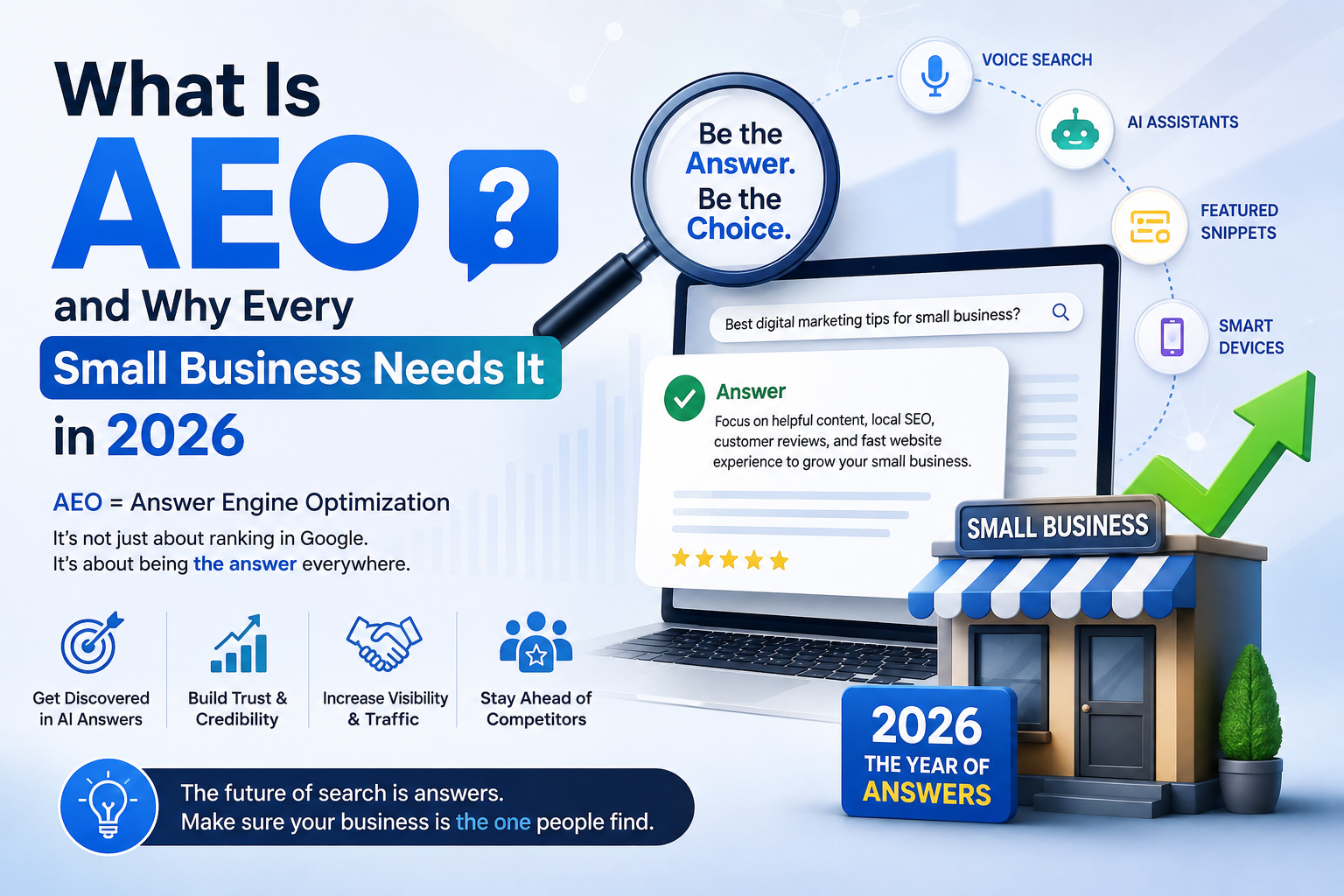
AEO stands for Answer Engine Optimization. It’s the practice of structuring your content so that AI-powered systems — ChatGPT, Perplexity, Google’s AI Overviews, Gemini, Copilot — can easily pull it, trust it, and cite it when they generate an answer for someone.
Think of it this way: SEO gets you a spot on the results page. AEO gets you a spot inside the answer itself.
That’s not a small distinction. When someone asks an AI assistant “what’s the best accounting software for a small retail business,” the assistant isn’t handing them ten links to click through and compare. It’s synthesizing an answer, possibly naming two or three brands, and moving on. If your business isn’t one of the names mentioned, you don’t just rank lower — you disappear from that conversation entirely.
AEO exists to prevent that disappearance.
How Is AEO Different From Traditional SEO?
They’re related, but they’re not the same job.
| Traditional SEO | AEO | |
|---|---|---|
| Goal | Rank high on a results page | Get cited inside a generated answer |
| Success metric | Rankings, organic traffic, CTR | Citation frequency, brand mentions in AI answers |
| What it targets | A human clicking a link | A machine selecting a source to quote or paraphrase |
| Content style | Keyword-optimized, link-friendly | Answer-first, clearly structured, fact-dense |
| Where it shows up | Google, Bing search results | ChatGPT, Perplexity, AI Overviews, Gemini, Copilot |
Here’s the part small business owners often miss: AEO doesn’t replace SEO. It builds on it. A technically sound, well-structured, authoritative website is still the foundation. AEO is what you layer on top so that same content also gets picked up by the systems increasingly standing between you and your customer.
Why Is AEO Suddenly a Big Deal in 2026?
Because the way people search has fundamentally changed, and it happened faster than most small businesses could adjust to.
A few numbers explain why this shift matters so much:
- Zero-click searches are now the majority, not the exception. Recent tracking shows well over 60% of Google searches in the US end without anyone clicking a website — and when an AI Overview appears on the page, that number jumps sharply higher, in some studies past 80%.
- AI Overviews now trigger on a large and growing share of tracked queries, and that share has been climbing fast year over year.
- Mobile users are already living in a zero-click world. Mobile zero-click rates run significantly higher than desktop, and mobile now accounts for the majority of all searches — which means the “answer on the page, no click needed” experience is already the default for most people, most of the time.
- Usage of AI summaries has outpaced trust in them. Research from 2025 found the majority of search users now rely on AI-generated summaries for a meaningful chunk of their queries, even though very few say they trust those summaries completely. People use them anyway, as a starting point — which means being named in that starting point matters even if it doesn’t directly send you a visitor.
Put simply: the AI answer is often the entire interaction now. If your business is named inside it, you’ve reached the customer at the exact moment they’re deciding. If you’re not, you’ve become invisible at the exact moment it mattered most — even if your website is technically ranking well.
For a small business competing against bigger players with bigger ad budgets, this is actually an opening. AEO doesn’t run on ad spend. It runs on clarity, structure, and trust signals — things a small, well-run business can absolutely compete on.
How Do AI Answer Engines Actually Choose What to Cite?
This is the part that trips people up, because it doesn’t work like traditional ranking.
AI answer engines aren’t scoring your page against 200 ranking factors the way Google’s core algorithm does. Most of them work by retrieving relevant content, extracting the clearest, most directly useful information, and synthesizing it into a response. A few things consistently make content easier to retrieve and more likely to get cited:
- A direct answer near the top. If someone asks “how much does landscaping cost per square foot,” and your page opens with a clear, specific answer before diving into context, that’s the block most likely to get pulled and quoted.
- Clean structure with question-based headings. Content organized around the actual questions people ask — not clever marketing headlines — maps directly onto how these systems search and extract information.
- Freshness. Answer engines lean toward recently updated content, especially for anything commercial or decision-related. Research into AI citation patterns has found the large majority of citations for buying-stage questions come from content updated within the past year.
- Consistent entity information. Your business name, location, services, and key facts need to say the same thing everywhere — your website, Google Business Profile, directories, social bios. Inconsistency creates doubt, and AI systems tend to avoid citing sources they can’t verify.
- Structured data (schema markup). FAQ schema, business schema, and article schema give these systems a machine-readable map of your content, which makes extraction far more reliable.
- Credible sourcing and specificity. Vague, generic claims get skipped. Concrete numbers, named examples, and clear reasoning get quoted.
None of this requires a massive budget. It requires deliberate structure.
Why Does a Small Business Need AEO Specifically?
It’s tempting to assume AEO is a “big brand” problem — something for enterprise SaaS companies fighting over AI citations. It’s actually the opposite. Small businesses have more to gain from AEO than almost anyone.
Here’s why:
- You’re competing on trust, not budget. A national chain can outspend you on ads. It usually can’t out-structure you on a genuinely useful, well-organized FAQ page. AEO rewards clarity and specificity, not ad spend — that’s a fight a small business can actually win.
- Local search is becoming answer-driven. Someone asking an AI assistant “which plumber near me offers emergency weekend service” wants a direct, confident answer, not a list of ten websites to compare. If your site clearly answers that exact question, you’re a strong candidate to be named.
- Brand visibility now happens before the click, not just after it. Even when the AI answer doesn’t send traffic, a customer who sees your business named as a trusted recommendation forms an impression. That impression shapes what they search for next, or what they type when they finally do click through.
- AEO strengthens your whole online presence, not just one channel. The same structural work — clear entity information, consistent NAP details, FAQ content, up-to-date pages — improves your local SEO, your Google Business Profile performance, and your site’s overall trustworthiness at the same time.
If your competitors haven’t caught on to AEO yet, and most small businesses genuinely haven’t, this is a real window to build an early advantage.
What Does AEO Look Like in Practice?
Theory is easy. Here’s what it actually looks like on a small business website.
Say you run a local bakery. A customer asks an AI assistant, “does [bakery name] make gluten-free birthday cakes?” For your business to have a shot at being the cited answer, somewhere on your site there needs to be a clear, specific, easily extractable statement — not buried in a paragraph about your bakery’s founding story, but structured plainly:
“Yes, we offer gluten-free birthday cakes in three sizes, available with 48 hours’ notice.”
That single sentence, placed under a question-shaped heading like “Do You Make Gluten-Free Cakes?”, does more for your AEO than a beautifully written but vague “about us” page ever will.
Practical steps to apply this across your site:
- Build a real FAQ section using the actual questions your customers ask — not guesses, but questions pulled from emails, calls, and reviews.
- Answer first, explain second. Lead every section with a direct, specific answer in one or two sentences, then add supporting detail underneath.
- Add FAQ schema markup so search engines and AI systems can read your questions and answers as structured data, not just page text.
- Keep your business facts identical everywhere — your site, Google Business Profile, Yelp, Facebook, industry directories. Small inconsistencies (a different phone number, a slightly different address format) erode machine trust.
- Update key pages regularly. A pricing page from three years ago is a liability in an AEO world — outdated information gets deprioritized or, worse, cited incorrectly.
- Write for a specific customer, not a search engine. Ironically, the more naturally you answer a real question, the better AI systems tend to extract and trust that answer.
AEO vs SEO vs GEO — What’s the Difference?
You’ll see all three terms thrown around, sometimes interchangeably, which causes real confusion.
- SEO (Search Engine Optimization): Optimizing to rank on traditional search engine results pages.
- AEO (Answer Engine Optimization): Optimizing to be selected and cited inside AI-generated answers.
- GEO (Generative Engine Optimization): A closely related, sometimes overlapping term for optimizing content specifically for generative AI platforms.
In practice, most small businesses don’t need to obsess over the exact boundary between AEO and GEO — the underlying work is nearly identical. What matters is understanding that all three sit on the same foundation: a technically sound, trustworthy, well-structured website. AEO is simply the layer that makes that foundation legible to AI.
What Are the Most Common AEO Mistakes Small Businesses Make?
Most AEO failures aren’t about doing something wrong. They’re about not doing anything at all, or doing the SEO version of the right idea without adapting it.
- Writing headlines for humans but not for questions. “Our Services” tells an AI system nothing. “What Services Do We Offer?” tells it exactly what the section answers.
- Burying the answer under three paragraphs of brand story. If the direct answer isn’t in the first few sentences, it’s far less likely to be extracted.
- Ignoring structured data entirely. Skipping schema markup is like writing a great answer and never labeling which question it answers.
- Letting business information drift out of sync across the website, directories, and social profiles.
- Treating AEO as a one-time project. Freshness matters. A page optimized once in 2024 and never touched again loses ground quickly.
- Chasing keyword density instead of clarity. AEO isn’t about repeating a keyword — it’s about answering a real question so clearly that a machine can lift the answer with confidence.
Pros and Cons of Focusing on AEO
Pros:
- Costs little beyond time and structure – no ad spend required
- Builds brand trust and visibility even when the click doesn’t come
- Strengthens local search and Google Business Profile performance as a side effect
- Levels the playing field against bigger-budget competitors
- Future-proofs your content against the ongoing shift toward AI-driven search
Cons:
- Harder to measure directly than traditional traffic and rankings
- Requires ongoing content updates, not a one-and-done fix
- Citation behavior varies across ChatGPT, Perplexity, and Google AI Overviews, so there’s no single formula
- Being cited doesn’t always translate into a visit, which can feel discouraging without the right expectations
The honest takeaway: AEO trades some measurability for a real shot at staying visible in a search landscape that’s moving away from clicks and toward answers.
How Do You Measure If AEO Is Working?
This is genuinely the hardest part, because AI platforms don’t offer the kind of clean analytics dashboards Google Search Console gives you. A few practical ways to track progress:
- Manually test your own questions. Ask ChatGPT, Perplexity, and Google directly the questions your customers would ask, and see whether your business shows up.
- Check referral traffic sources. Analytics platforms can show visits arriving from chatgpt.com, perplexity.ai, and similar domains — a small but growing signal.
- Track brand mention volume over time, even informally, by periodically testing the same set of prompts and noting whether your business appears more consistently.
- Watch for increases in branded search — when AI answers mention a business by name without linking to it, curious customers often search the name directly afterward.
It won’t be as precise as a rankings report. But directional progress is still real progress.
Final Thoughts
AEO isn’t a trend to watch from a distance — it’s already reshaping how customers find local and small businesses, whether those businesses have noticed or not. The good news is that AEO doesn’t require a bigger budget than your competitors. It requires clearer thinking: answer real questions, structure content honestly, keep your facts consistent, and keep everything current.
Do that consistently, and you’re not just optimizing for search engines anymore. You’re optimizing for the moment a customer asks a question and an AI system decides whose answer to trust.
Frequently Asked Questions
What does AEO stand for? AEO stands for Answer Engine Optimization — the practice of structuring content so AI-powered systems like ChatGPT, Perplexity, and Google AI Overviews can retrieve, trust, and cite it when generating answers.
Is AEO the same as SEO? No, though they’re closely related. SEO focuses on ranking on a search results page for a human to click. AEO focuses on getting selected and cited inside an AI-generated answer, whether or not a click ever happens.
Do small businesses really need to worry about AEO in 2026? Yes. Zero-click searches now make up the majority of queries, and AI answer engines are increasingly the first — sometimes only — touchpoint a customer has with a business before making a decision. Small businesses that ignore AEO risk becoming invisible in that moment, regardless of how well they rank traditionally.
How is AEO different from GEO? GEO (Generative Engine Optimization) is a closely related term often used interchangeably with AEO. Both involve structuring content for AI-driven platforms rather than traditional search results pages. For most small businesses, the practical steps overlap almost completely.
Does AEO replace the need for traditional SEO? No. AEO builds on a strong SEO foundation — a technically sound, authoritative, well-structured website. AEO is the additional layer that makes that same content easier for AI systems to extract and cite.
How long does it take to see results from AEO? There’s no fixed timeline, and it varies by platform and industry. Because freshness and structure matter heavily, businesses that update key pages regularly and maintain consistent, answer-first content tend to see citation opportunities improve steadily over a few months rather than overnight.

 Call Us: 9988447232
 Email: